Presenting 'The Lord of the Rings', a limited edition deluxe 14LP vinyl box set of the original 1981. BBC Radio full-cast dramatisation of JRR Tolkien's masterpiece, released for the first time in its original 26-episode broadcast format. Over 13 hours of newly-mastered audio drama in superb stereo sound with every tense cliffhanger (and stirring theme music reprise) intact, plus a standalone bonus disc of the series' celebrated soundtrack by the renowned composer Stephen Oliver.
Known to be admired by The Lord of the Rings filmmaker Peter Jackson, the BBC radio drama, chronicling Frodo Baggins’ epic quest in Middle-earth, features acting legends including Ian Holm (Alien, The Lord of the Rings & The Hobbit, Chariots of Fire) as Frodo, Michael Hordern (Barry Lyndon, Gandhi, Paddington) as Gandalf, John Le Mesurier (Dad’s Army) as Bilbo, Bill Nighy (Love Actually) as Sam, and Robert Stephens (Romeo and Juliet) as Aragorn, as well as Gerard Murphy (Waterworld, Batman Begins), Peter Vaughan (Game of Thrones), Simon Cadell (Watership Down)and Michael Graham Cox (The Stone Tape).
The highly collectable Deluxe Limited Edition Box Set, sumptuously packaged and individually numbered, comes with the LPs pressed on Clear and Forged Gold coloured Vinyl, and includes newly commissioned, exquisitely detailed artwork re-imagining the landscape of Tolkien’s Middle-earth on the packaging and record sleeves, full cast and credits for each episode, and an 8-page booklet featuring behind-the-scenes cast photos and a note about the making of the series by dramatist Brian Sibley. It is also available as an individually numbered 14-CD box set in 7” size with deluxe packaging and booklet.
I have been wanting to post about this for quite a long time.
The BBC are re-issuing the 1981 broadcasts of the Lord of the Rings in time for Christmas.
I have been told that these are the original 30-minute episodes, which were only ever broadcast twice in 1981. The subsequent releases were two episodes combined into one 60-minute episode.
The episodes did have cliffhangers at every 30 minutes and these will now be available to listen to again. The recordings are also from the original master-tapes which the BBC still have.
I will add more details when they are announced by the BBC.
Art by Emily Austin, Matej Cadil, Anke Eissmann, Miriam Ellis, Spiros Gelekas, Donato Giancola, Octo Kwan, Ruth Lacon, MGCoco, Ted Nasmith, Gordon Palmer, Michael Taaffe.
The Calendar is 11 x 8 1/2", opening out to 11 x 17", with art above and calendar grid below. It shows real-world holidays, Middle-earth dates and important events in Tolkien's life.
To pay by mail: send check or money order (in US $, drawn on a US bank) payable to Nancy Martsch, PO Box 55372, Sherman Oaks, CA 91413, USA. I can accept US currency: use a sturdy envelope, send at own risk. Please include your shipping address with your order. And a contact e-mail address, if you have one.
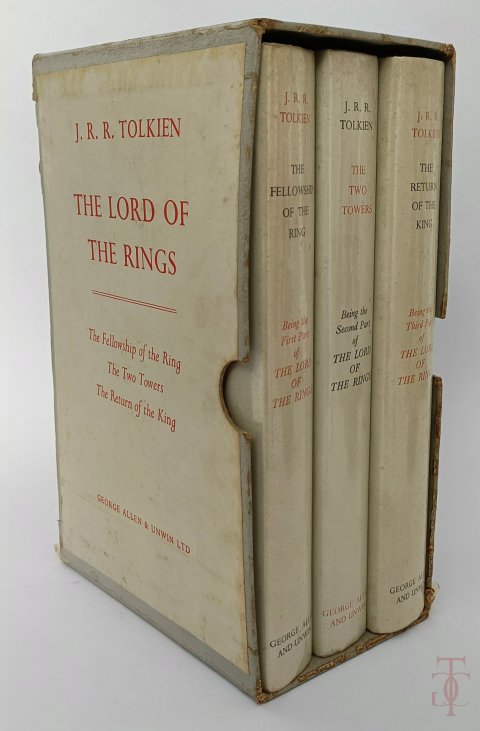
The Lord of the Rings. London: George Allen & Unwin Ltd., 1961 BOLDLY SIGNED BY THE AUTHOR IN EACH VOLUME in blue ballpoint pen on preliminary blank, later impressions (Fellowship: 11th impression; Two Towers and Return: 8th impression), half-titles, illustrations, maps including folding maps at the end of each volume, original red cloth, spines lettered in gilt, top edges red, lacking dust-jackets, the odd stray spot at margins, extremities very slightly rubbed [With, loosely inserted:] 1 page autograph note explaining the Creation myth of Middle Earth and proposing the presentation of a copy of Tree and Leaf A BOLDLY SIGNED SET OF TOLKIEN'S LEGENDARY TRILOGY, TOGETHER WITH A REMARKABLE AUTOGRAPH NOTE ON THE MYTHIC CREATION OF THE RACE OF DWARVES, A UNIQUE RECORD OF THE AUTHOR'S UNLIKELY FRIENDSHIP WITH AN AVID FAN. These volumes, alongside the extraordinary autograph note, were both presented by the author to Eileen Elgar, a known correspondent. In a letter to his grandson of 16 October 1963, Tolkien describes Eileen as an "admirer" who lives near to the Hotel Miramar in Bournemouth, noting that she is "highly intelligent & well-read" though sadly "stone deaf", necessitating the arduous process of conversation "by writing pad" (Letter 249, Letters of J.R.R. Tolkien, p. 334) The autograph note included in the present lot, loosely inserted in Fellowship of the Ring, appears to be a product of the cumbersome method of communication necessitated by Eileen's disability: it is hastily penned in ballpoint on a scrap of lined notepaper and with two crossed-out words on the bottom of the verso not obviously connected to the main prose. However, it is clearly also the product of a lively, in-depth discussion, and delves into significant detail regarding Middle Earth Creation lore: *"Only the Creator could "create". To attempt to do was a prime sign. The Valar were however in great desire to see Elves and Men. Aule (one of the Valar) tried to 'make' them in secret. God knew this; but Aule was so humble and repentant that God accepted them, and gave them life. — but they had to sleep until His own children (Elves & Men) went in the world. 'Aule's people' are the Dwarves". The Creation myth sketched out in this note would later be expounded upon by the author more fully in the chapter "Of Aulë and Yavanna" in The Silmarillion. On the verso of the note, Tolkien asks Eileen whether she would "like a copy of [his] next book, which contains a short story called Leaf by Niggle (about an artist)". Tolkien evidently kept his promise: see lot 86.
(i) The Hobbit or There and Back Again. London: Puffin Books, 1961. SIGNED BY THE AUTHOR TO UPPER MARGIN OF HALF-TITLE in blue ballpoint pen ("J.R.R. Tolkien"), 8vo, first paperback edition, original wrappers by Pauline Baynes, minor wear to extremities
(ii) The Lord of the Rings. London: George Allen & Unwin Ltd./Boston: Houghton Mifflin Company, 1963. EACH VOLUME SIGNED BY THE AUTHOR TO HALF-TITLE in black ballpoint pen ("J.R.R. Tolkien"), deluxe edition, later impressions (thirteenth impression [volume one], tenth impression [volumes two and three]), 3 volumes, 8vo, illustrations, maps including folding maps at the end of each volume, black buckram, spines lettered in gilt, edges gilt, original ribbon bookmarks, housed in original slipcase by Pauline Baynes, spine of volume two slightly faded (as usual)
A HANDSOME GROUP, SIGNED FOR TOLKIEN'S FRIEND AND DEDICATED FAN EILEEN ELGAR.
The Adventures of Tom Bombadil. Cambridge: Houghton Mifflin Co. Boston, 1963 FIRST AMERICAN EDITION, FIRST PRINTING, PRESENTATION COPY, SIGNED BY THE AUTHOR TO THE FRONT FREE ENDPAPER in black ink, 8vo, in-text illustrations, pictorial boards, dust-jacket, minor edgewear [with, loosely inserted:] Autograph letter signed ("Ronald Tolkien"), to Eileen Elgar, thanking her for her postcard from Barbados, presenting her with "the promised copy of my book of verses, with best wishes for Christmas", outlining bibliographical differences between the English and American first editions, and REFERENCING HIS SADNESS AT THE DEATH OF HIS FELLOW AUTHOR AND INKLING ("I have been very much bereaved by the death of my friend C.S. Lewis on November 22nd"), 2 pages, headed stationery of 76 Sandfield Road, Headington, Oxford, 14 December 1963
Tree and Leaf. London: George Allen & Unwin, 1964 FIRST EDITION, hardback, PRESENTATION COPY, SIGNED BY THE AUTHOR in black ballpoint pen, WITH AUTOGRAPH NOTE FROM THE AUTHOR PRESENTING THE VOLUME loosely inserted (previously taped in), 8vo, title-page with facsimile of Tolkien's signature, publisher's dark green textured cloth, spine stamped in gilt, dust-jacket, small areas of old tape residue to front flap of dust-jacket and front free endpaper, dust-jacket slightly browned and frayed FIRST EDITION, WITH A HEARTFELT AUTOGRAPH NOTE FROM THE AUTHOR TO EILEEN ELGAR, SENDING HER "A SMALL GIFT WITH VERY BEST WISHES". The note, penned in Tolkien's distinctive hand in black fountain pen, is dated "Dec. 13 1967", suggesting that he presented this attractive volume to Eileen as a Christmas gift. (Tolkien is known to have presented another copy of the same edition to another recipient, Elizabeth Jennings, also as a Christmas present with an accompanying note). Tolkien had previously discussed giving Eileen a copy of Tree and Leaf when he met her in person, suggesting that she might find the short story Leaf by Niggle of particular interest (see lot 83). He appears to have sent her a copy of the paperback issue before the present volume, as a typed letter signed inserted in that copy is dated 29th August 1966 (see next lot). In the note accompanying the present volume, Tolkien adopts an apologetic and vulnerable tone:
"Dear Mrs Elgar, I send you a small gift with very best wishes. I have not forgotten — but I have had an unusually troubled time: with a weight of business and other cares, leaving no time for letters, and ending in an illness of my own since September from which I am now slowly recovering. Yours sincerely Ronald Tolkien".
It is noteworthy that he signs off as "Ronald Tolkien" (rather than the more formal "J.R.R. Tolkien"), revealing the warmth of his developing friendship with Eileen.
Typed letter signed, to Eileen Elgar, mentioning his work on the Silmarillion and discussing his travel plans, 1 page, headed stationery of 76 Sandfield Road, Headington, Oxford, 29 August 1966, previously folded [loosely inserted into:] Tree and Leaf. London: Unwin Books, 1964. FIRST EDITION IN PAPERBACK, 8vo, facsimile of Tolkien's signature on title-page, publisher's pictorial wrappers, wrappers slightly toned and delaminating at edges Tolkien had promised Eileen a copy of Tree and Leaf (see autograph note accompanying lot 83) and he later sent her a copy of the first hardback edition (see previous lot). In the letter accompanying the present volume, the author thanks Eileen for her "long letter of the 20th August" and apologises "for [his] neglect of [her] during the recent months", owing to a busy schedule and "more anxieties than my health and time can cope with". Tolkien looks forward to a "long needed" foreign holiday with his wife on a cruise to Smyrna, and sympathises with Eileen's chronic ear condition (she had been deaf since birth), praising her stoicism. Also notable is the letter's reference to Tolkien's ongoing struggle to compose the collection of mythopoeic writings that had initially begun working on half a century previously, but which would remain unfinished upon his death in 1973 ("I have got no further with The Silmarillion, but hope to get on with it when I return in the autumn").
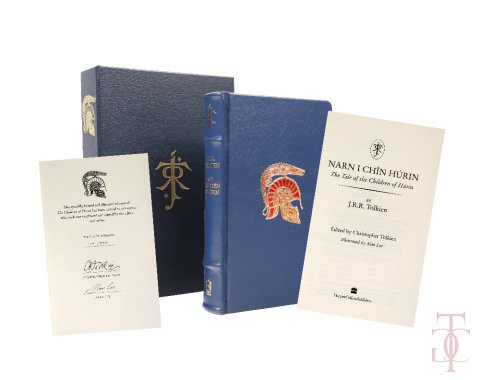
One of 500 Super Deluxe Copies Only Tolkien (J.R.R.) Narn, Chin Hurin The Tale of the Children of Hurin, 8vo edited by Christopher Tolkien, illustrated by Alan Lee, Signed Limited Super Deluxe Edition No. 119 (500) copies, marbled endpapers, full blue leather with helmet motif on front cover, gilt lettered spine, a.e.g., in full matching leather clam box.
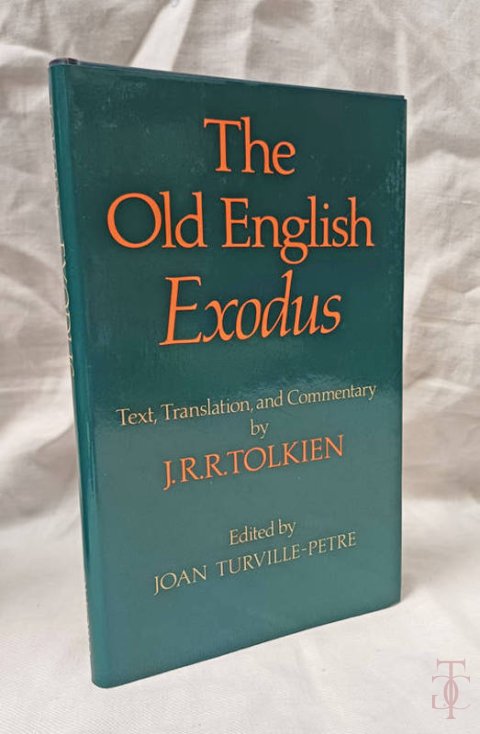
THE OLD ENGLISH EXODUS, TEXT, TRANSLATION AND COMMENTARY BY J.R.R. TOLKEIN, EDITED BY JOAN TURVILLE-PETRE, ONE OF ONLY 3000 COPIES, WITH DUST JACKET - 1981 Condition Report: Overall a very good copy
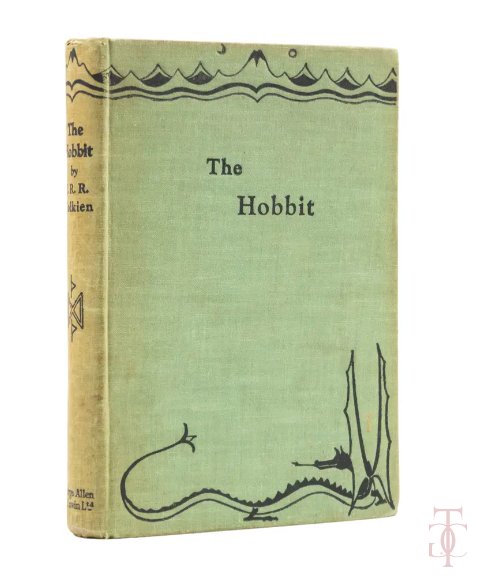
Tolkien (J.R.R.) The Hobbit, first edition, first impression, frontispiece, one plate and 8 illustrations, including 7 full-page, map endpapers printed in red & black, all by the author, short nick to pp.191-193 head, occasional marginal spotting, more so at endpapers, faint finger-soiling to one or two pp., cracking to gutter, overall holding firm, original cloth, slight spotting and toning to spine, some staining to lower board, light bumping and fraying to spine ends, margins slightly darkened, edges foxed, [Hammond A3a], 8vo, 1937.
Estimate: GBP 8,000 - 12,000 Sold for GBP 37,800 including fees
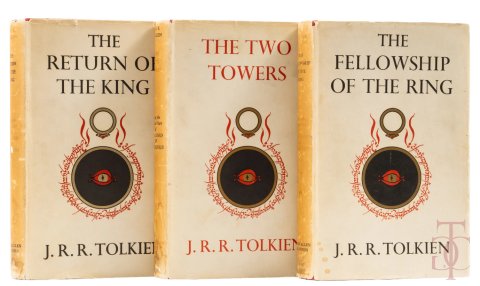
Tolkien (J.R.R.) The Lord of the Rings, 3 vol., comprising The Fellowship of the Ring, light toning strips to endpapers, one or two minor marginal spots, spine ends fractionally rubbed, 1954; The Two Towers, p.352 slightly creased, cloth joints lightly marked, ink ownership signature and notes to dust-jacket lower panel, 1954; The Return of the King, state with signature mark "4" and aligned text on p.49, dust-jacket without review after The Return of the King on lower flap, light surface-soiling on rear pastedown, a few light marks to covers, some minor nicking to dust-jacket upper panel foot, short tear at spine foot lower joint, 1955, first editions, first impressions, maps at end, original cloth, dust-jackets, spines browned and stained, creasing and chipping to spine ends, a few light spots to front and rear panels, overall very good copies, [Hammond & Anderson A5], 8vo.
Estimate: GBP 8,000 - 12,000 Sold for GBP 25,200 including fees
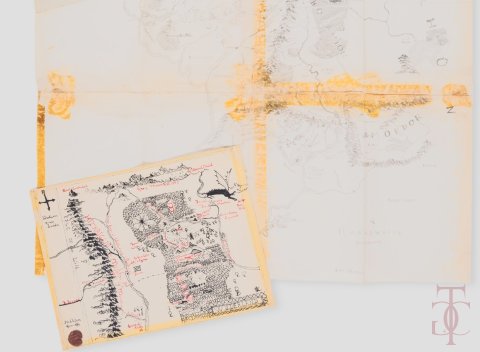
Tolkien (J.R.R.).- Best (David) The Adventures of Tom Bombadil and other poems from The Lord of the Rings translated into runes, 4 vol. notebooks bound in 1, manuscript in pencil and ink, 2 Autograph Letters signed from Tolkien thanking Best for sending the translations and praises his work "It seems very correct. I am glad you used the genuine English runes (as in The Hobbit)", May 1967 (folds), Autograph Note signed in a secretarial hand "With best wishes from Professor Tolkien", Autograph Letter signed by Best to Tolkien with Tolkien's translation of a line from the back cover of The Road Goes Ever On in pencil, loosely inserted, maps and illustrations copied from Tolkien's works (some loosely inserted), tape repairs, light soiling and rubbing, original card wrappers bound in, modern cloth-backed boards, manuscript label laid down on upper board, custom pictorial slip-case replicating The Road Goes Ever On cover, [c.1967]; and very good copies of Tolkien's The Adventures of Tom Bombadil, with David Best's ownership signature in English and Elvish, and The Road Goes Ever On, v.s. (small bundle)
***A unique and personal archive of notebooks, illustrations and correspondence relating to J. R. R. Tolkien compiled by David Best, a dedicated fan, in school exercise books as a teenager in the late 1960s.
After reading Tolkien's works, Best became captivated by the tales of fantasy and adventure, in particular with the runes in which the secret message was written on Thorin Oakenshield’s map. He then mastered the elven systems as well as Runes and there are various writings in the notebooks including transcriptions of Tolkien's English poems into runic script, as well as maps at varying scales and illustrations copied by hand. Best sent off these notebooks to Tolkien who wrote back thanking him for his efforts and supplied corrections. Featured on the BBC's The Repair Shop in 2022, the collection was subsequently restored and rebound by Chris Shaw in a bespoke binding and slipcase.










 54
54